Do you find the calculations interesting ? If yes, then try Neri calculator free for 1-day by clicking on the following link: Software Cooling-Tower.
Pages
Build and/or verify cooling tower performance and efficiency with TURBOsplash PAC ®™ and NERI Calculator
Labels
Comments on cooling tower
(1)
Cooling Tower Calculations
(28)
Cooling Towers
(18)
Cross-flow and Counter-flow
(25)
Energy
(37)
Environment
(35)
Evaporative Cooling Towers
(42)
Geothermal Energy
(5)
Heat Transfer
(15)
How to Design the Water Cooling Towers
(34)
How to Design Water Cooling Towers
(25)
NERI Calculator
(15)
Optimizing
(7)
Software cooling tower
(6)
TURBOsplash PAC ®™
(24)
Water
(27)
Water Cooling Tower
(28)
Water Cooling Towers
(4)
What happens inside TURBOsplash PAC
(6)
what happens inside TURBOsplashPAC ® TM
(7)
Why install TURBOsplash PAC ®™
(4)
Why install TURBOsplashPAC ® TM
(11)
Showing posts with label TURBOsplash PAC ®™. Show all posts
November 18, 2019
November 11, 2019
September 9, 2019
TURBOsplash PAC ®™ - What is it?
TURBOsplash PAC ®™ is a filling material for systems that exploit the physical principle of "mass transfer" to migrate from one element to another.
TURBOsplash PAC ®™ is employed in water cooling towers, where the two elements are water and air. This material is used by prestigious companies that build cooling towers or replace/retrofit traditional material (film and grids). As a result, the increased performance is sensitive and allows for a long functioning period. TURBOsplash PAC ®™ was invented by Bruno Neri and now commercialised by TSI company and other partners under authorized license. It is patented in most industrialized countries, where it is installed and in use with satisfied customers for over 25 years.
September 2, 2019
August 19, 2019
August 12, 2019
Feedback from our followers
A follower commented: "I had no idea what cooling towers were used for. "
Today's cooling towers have come a long way from the old and inefficient simple heat exchanger of their ancestors.
![]() |
| An old cooling tower |
This aim of this blog is to continue contributing to improving cooling tower efficiency and performance, by understanding and resolving problems that could result from bad tower design and/or management.
August 5, 2019
Evaporative Panels for all WATER COOLING TOWERS - Modular Polypropylene Injection Molded
TURBOsplash PAC ®™ is a bottom supported modular evaporation panel system for making cooling tower fill modules.
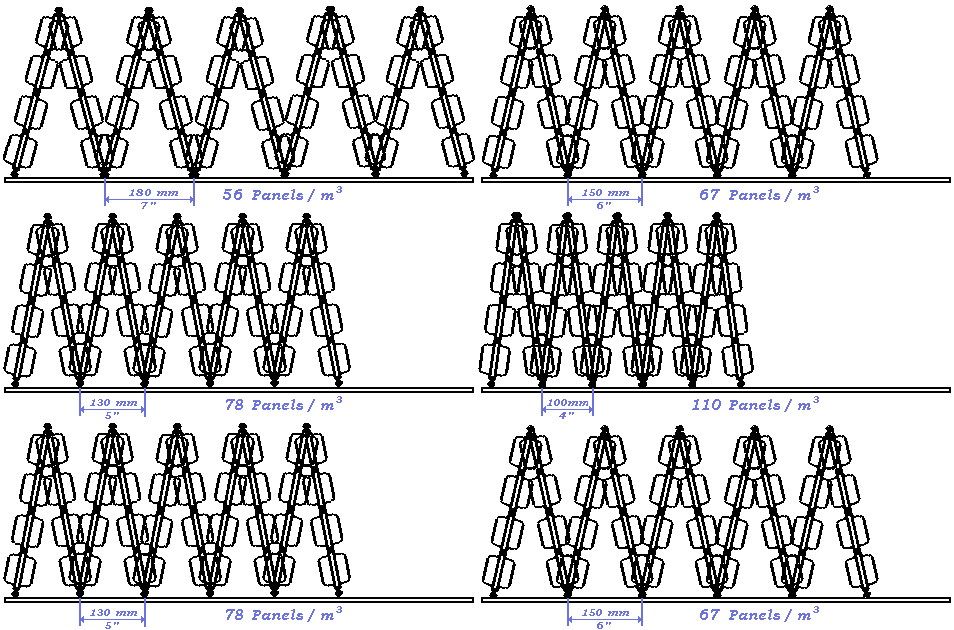
TURBOsplash PAC ®™ panels are injection molded in polypropylene, constructed with a 300mm (@1 foot) by 600mm (@2 feet) U-channel framework and with a total of 38 blades molded perpendicular to this framework.
The panels are manufactured with molded-on spacer straps, which are used in conjunction with pins molded on the panel ends to stabilize different triangular structures in any of six density/widths.
Concerning Wet Bulb Temperature
What is Wet bulb ? Cooling tower cools water by evaporating some of the water, and water cannot evaporate once air is 100% saturated. At wet bulb temperature air is 100% saturated, therefore water cannot be cooled below wet bulb temperature.
July 29, 2019
TURBOsplash PAC ®™ - A versatile fill material for a cost-effective solution
The following pictures show the versatility of TURBOsplash PAC ®™ fill material for evaporative cooling towers; that is, the same panel offers various possibilities to create different configurations with minimum warehouse immobilization.
![]() |
| 2 layer |
![]() |
| Example of 5 different configurations |
![]() |
| Panel configuration |
![]() |
| Panels come with joining strips |
![]() |
| Loading container |
![]() |
| Ready for loading |
![]() |
| Ready for air shipment |
July 22, 2019
Installation of TURBOsplash PAC ®™ in Field Erected FRP Cooling Tower
The picture shows the work in progress of installing TURBOsplash PAC ®™ fill material in field erected cooling tower made of FRP (Fiber Reinforced Polymer).
July 15, 2019
TURBOsplash PAC ®™ installation progress
The following pictures illustrate the work progress of TURBOsplash PAC ®™ fill material to be installed in erected counter-flow cooling towers.
July 8, 2019
Retrofitting with TURBOsplash PAC ®™ to increase efficiency
These pictures illustrate a few aspects of a recent job carried out with success and much satisfaction. The job entailed substituting old film with TURBOsplash PAC ®™ installed in different layers, and with different configurations to improve the efficiency of the cooling tower.
| TURBOsplash PAC installed each layer of different configuration |
![]() |
| TURBOsplash PAC ready to install |
June 24, 2019
Industrial water cooling with TURBOsplash PAC ®™ installed in severe conditions
TURBOsplash PAC ®™ installed and functioning with water containing high percentage of oil and grease.
|
| Installed fill film with water containing high percentage of oil and grease. |
![]() |
| TURBOsplash PAC ®™ ready for installation in the tower. |
![]() |
| Cooling tower with TURBOsplash PAC ®™ installed in severe conditions. |
June 17, 2019
Installing TURBOsplash PAC ®™ panels
Photos illustrate the installment of TURBOsplash PAC ®™ fill material panels in a cross-functional water cooling tower.
June 10, 2019
TURBOsplash PAC ®™ fill material panels
Images of TURBOsplash PAC ®™ fill material panels, packaged and prepared for shipment/install in cooling towers.
February 18, 2019
What happens if the cooling tower is not working properly and the plant is blocked? First thing: do not panic!
![]() |
| What happens if the cooling tower is not working properly and the plant is blocked? First thing: do not panic! |
Many things could go wrong! We might not even be aware of the many inconveniences that can occur to an industrial plant when the water cooling tower is not working properly.
Some of the causes are:
- malfunctioning of one or more components that make up the tower (breakage, wear, fluid hammer, high temperature)
- encrustation, algae, and clogging of the water or air side passages
- bad design
We shall focus on the last point, i.e., bad design.
Bad design is due to:
- thermal load assessment error
- water tower temperature outlet assessed with great accuracy
- wrong design assumption for the wet-bulb air temperature
What will happen in the various plants?
Usually, the tower used in industry serves:
- steelworks
- refineries
- plants for the production of chemical products
- others
For each different plant, the damage caused by a non-functioning tower can be calculated in terms of production lost.
In the next posts, we will analyze the risk and try to resolve bad accuracy in the design work with the help of our followers.
October 29, 2016
A cooling system is essential for the operation of any modern geothermal power plant
Cooling Tower System: Converting Geothermal Energy into Electricity
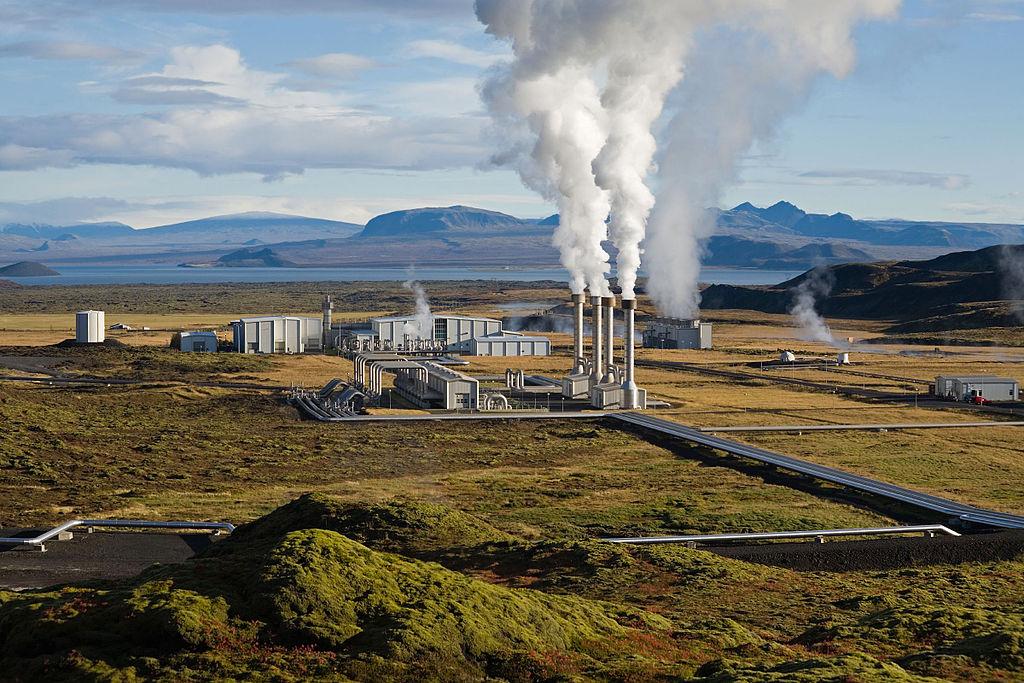
| Example of flash power plant producing electricity |
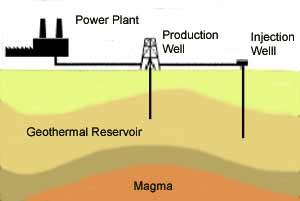
Heat emanates from the earth's interior and crust generates magma (molten rock). Because magma is less dense than surrounding rock, it rises but generally does not reach the surface, heating the water contained in rock pores and fractures. Wells are drilled into this natural collection of hot water or steam, called a geothermal reservoir, in order to bring it to the surface and use it for electricity production.
The whole process of turning hydro-thermal resources into electricity is based on conversion technologies. That is, there are three basic types of geothermal electrical generation facilities:
- binary (it function as closed loop systems that make use of resource temperatures as low as (74°C),
- steam (it makes use of a direct flow of geothermal steam), and
- flash (uses a mixture of liquid water and steam).
Flash power plant is the most common and it uses a mixture of liquid water and steam.
The type depends on reservoir temperatures and pressures. Each type produces somewhat different environmental impacts.
Example of flash power plant producing electricity
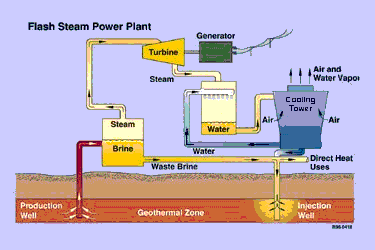
The most common type of power plant to date is a flash power plant (flash steam is the condensation caused by reducing pressure) with a water cooling system, where a mixture of water and steam is produced from the wells. The steam is separated in a surface vessel (steam separator) and delivered to the turbine, and the turbine powers a generator.
Example of flash power plant producing electricity
The most common type of power plant to date is a flash power plant (flash steam is the condensation caused by reducing pressure) with a water cooling system, where a mixture of water and steam is produced from the wells. The steam is separated in a surface vessel (steam separator) and delivered to the turbine, and the turbine powers a generator.
A cooling system is essential for the operation of any modern geothermal power plant, because cooling towers prevent turbines from overheating and prolong facility life. Most power plants, including most geothermal plants, use water cooling systems.
Water cooled systems generally require less land than air cooled systems, and are considered overall to be effective and efficient cooling systems. The evaporative cooling used in water cooled systems, however, requires a continuous supply of cooling water and creates vapor plumes. Usually, some of the spent steam from the turbine (for flash- and steam-type plants) can be condensed for this purpose.
Reliability of Geothermal Power Generation
The source of geothermal energy, heat from the earth, is available 24 hours a day, 365 days a year. Solar and wind energy sources, in contrast, are dependent upon a number of factors, including daily and seasonal fluctuations and weather variations. For these reasons, electricity from geothermal energy is more consistently available, once the resource is tapped, than many other forms of electricity.
Examples of Power Plant Size and Applications
Though the size of a power plant is determined primarily by resource characteristics, these are not the only determining factors. Factors that favor the development of larger geothermal plants include things such as cost decreases when larger quantities of materials, including steel, concrete, oil, and fuel, are purchased at one time.
Cooling System
Most power plants, including most geothermal plants, use water-cooled systems – typically in cooling towers.
References/Sources
- Idaho National Lab (INL)
- Wikipedia
- Geothermal Energy Association
- U.S. Department of Energy
|
**********
Software Calculator for cooling tower design and maintenance and TURBOsplash PAC ™ for filling material.
**********
October 24, 2016
The function of Cooling Towers with Geothermal Energy
Use of Cooling Towers with Geothermal Energy
1. What is geothermal energy?
Geothermal energy derives from the heat of the earth’s core. Here we will refer to energy deriving from the core of the earth. Based on new research, the earth’s core temperature is believed to be anywhere between 6000°C and 6500°C. This intense heat is absorbed by the different layers of the earth and, consequently, this heats our planet.
This geothermal energy can be used to generate geothermal power and is the source of our hot springs, volcanoes and geysers.
2. How is geothermal energy harnessed?
Geothermal energy is heat that is extracted from the earth. Pressurized hot water and steam, is produced when groundwater meets with the molten magma ascending from the earth’s core. Hot water flows to the surface through wells. Once pressure is released, the water flashes to steam. Deep wells, a mile or more deep, can tap reservoirs of steam or very hot water that can be used to drive turbines which power electricity generators.
3. How are cooling towers used with geothermal energy?
Let's suppose steam is separated from the water and this steam is used to drive a turbine generator. Conventional cooling towers are used to condense steam on the low-pressure side of the turbine to maximize electrical generation efficiency. Either direct condensers or surface heat exchanger condensers are utilized. In most cases, the condensate is used as makeup for the cooling towers. There is excess condensate available and this means that cooling towers run at low cycles. Low cycle operation results in excessive cooling tower treatment costs unless programs can be employed that are effective at low dosage rates.
4. Neri Calculator for cooling tower design and maintenance and TURBOsplash PAC ™ for filling material.
Geothermal power plants are designed with corrosion resistant materials of construction such as stainless steel in order to withstand the trace contaminants that enter the cooling systems with the steam.
Cooling towers, if properly sized and filled with high efficiency fills, will yield optimal performance.
**************
1. University of Florida
2. International Geothermal Association
3. Wikipedia
October 1, 2016
The importance of water in the cooling tower industry - Water (part 8)
COOLING TOWER
Cooling tower design require water and air related data.
Data concerning the water include flow rate, water temperature going into the tower, and temperature going out of the tower. This data is provided by the cooling tower plant design.
Data concerning the air is provided by weather statistics site where the tower is located or where it will be installed, and is given in percentage hours per year or summer dry bulb temperature and relative humidity, measured at the same instant of detection of the dry bulb temperature.
The amount of air required in the tower is given by the design results, and the size of the cooling tower depends directly on this data.
Hence, one must determine the air velocity inside the tower, the power of the fan motors, and all the characteristics of the tower sized based on the efficiency of individual components, including the main component which is the fill material that allows heat exchange of water / air.
Cooling tower design require water and air related data.
Data concerning the water include flow rate, water temperature going into the tower, and temperature going out of the tower. This data is provided by the cooling tower plant design.
Data concerning the air is provided by weather statistics site where the tower is located or where it will be installed, and is given in percentage hours per year or summer dry bulb temperature and relative humidity, measured at the same instant of detection of the dry bulb temperature.
The amount of air required in the tower is given by the design results, and the size of the cooling tower depends directly on this data.
Hence, one must determine the air velocity inside the tower, the power of the fan motors, and all the characteristics of the tower sized based on the efficiency of individual components, including the main component which is the fill material that allows heat exchange of water / air.
April 6, 2016
Appreciations for our blog
We like to thank everyone for visiting our blog and have shared our experience in Cooling Tower industry. Up to today, our blog "Cooling Tower", containing 84 posts, was seen approximately by 3000 visitors 7000 times, of which some visited the blog more than once.
Subscribe to:
Posts (Atom)


.png)