Showing posts with label How to Design the Water Cooling Towers. Show all posts

January 6, 2020

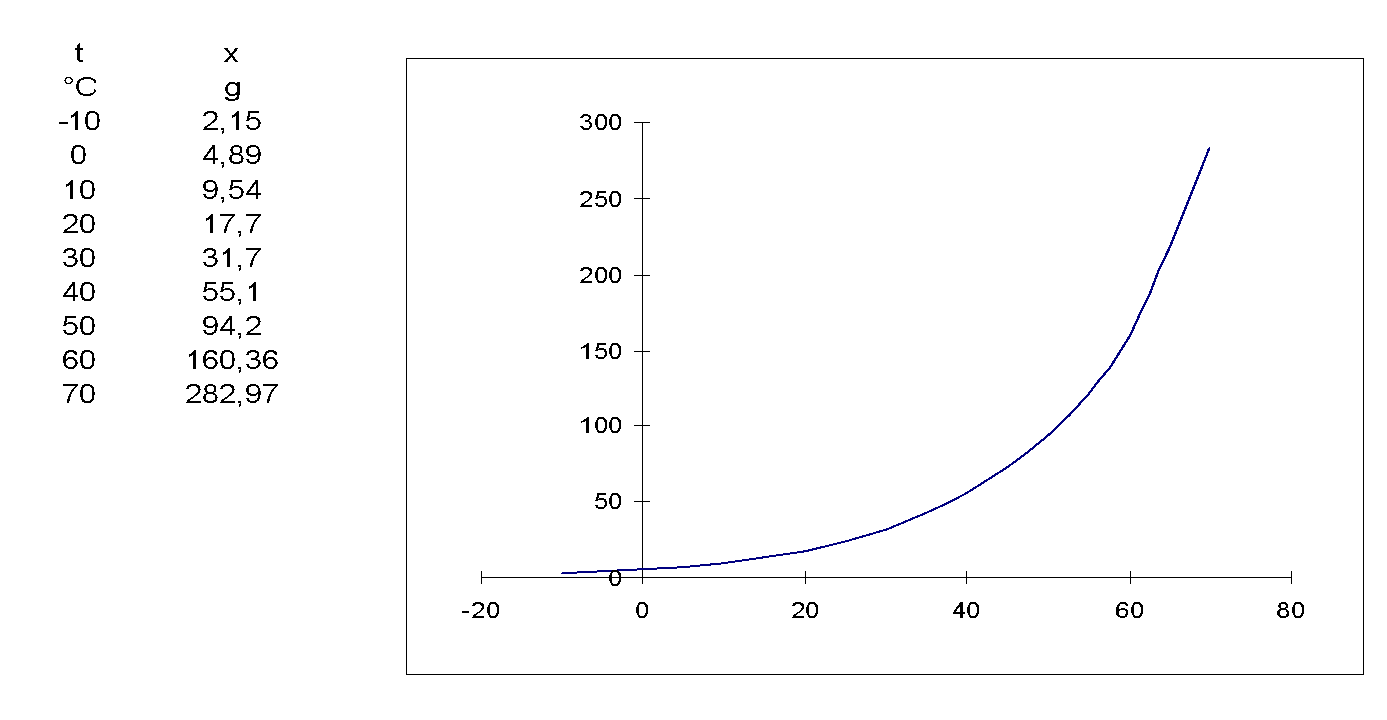
Amount of water in air

Water by weight contained in 1  m3 of saturated water
( C.A. Cavalli Termodinamica industriale – Hoepli)


Tempearture in oC Contained water (grams of water vapor) g
-10 2.15
0 4.89
10 9.54
20 17.7
30 31.7
40 55.1
50 94.20
60 160.36
70 282.97


Relative humidity is the percentage of water vapor contained in the air contains under certain conditions, that is, in relation to the quantity of water vapor contained in saturated air under same conditions.

For example:

If relative humidity is 80% and the temperature of 20 ° C, since saturated air contains 17.7 g / m3, the air taken from environment is considered to contain 80% of the water, or better 0.8×17.7 = 14.6 grams of water per m3.

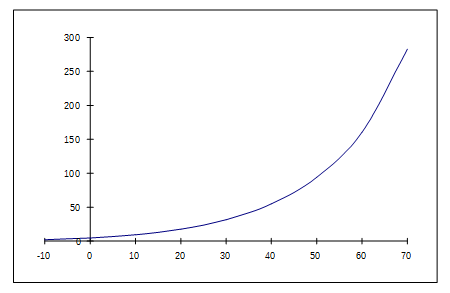
Data table (grams of water per mas a function of temperature)

t (oC) -10 0 10 20 30 40 50 60 70
x (g) 2.15 4.89 9.54 17.7 31.7 55.1 94.2 160.36 282.97


Graph (grams of water per m3 as a function of temperature)


December 30, 2019

Why cool the water (part 4)

Range of process plants that can be cooled with evaporative systems. Importance of volumes of energy to be disposed of. Cost-effectiveness of the cooling system.

For high volumes of heat to be disposed, evaporative systems are much used for cooling water, relatively to the amount of water used to transport the same heat. That is, water with a big difference in temperature between hot water and cold water (more than 5 ° C) .

What data is needed for sizing water cooling system. 

Water and air are the two main elements for an evaporative water cooling system.
The data for doing calculations are: 
  • water inlet temperature, outlet temperature, amount to cool within a unit of time,
  • air room temperature (from dry thermometer) and relative humidity or temperature from wet thermometer,
  • the amount of air, and the speed set by the designer, are the result of sizing the plant.
Nature of the system. 
  • Period of operation: "batch" or continuous.
  • Production: quantity.
  • Energy (power) used.
Energy (heat) brought outside the process plant by means of the finished product in the form of material quantity and temperature difference of the material between the beginning and the end of the process.

In the case of exothermic production processes: heat development during the process (for example, in chemical plants - Pharmaceutical) and determination of the amount of heat produced during the process.

How to measure the efficiency of an evaporative cooling system. 

Normally, with time, the efficiency of the cooling system decreases due to: 
  • Deterioration of the plant's construction material.
  • Wear and tear of the system's moving parts, for example: fans electric motors, water recycle pumps.
  • Loss of efficiency of the system filling material due to limescale deposits or mucilage, dramatically changing the predesignated air flow rate set as design data.
What are the consequences the decreased efficiency of a cooling system.

The lesser efficiency of the cooling system is directly proportional to the lesser efficiency of the driven system. The consequences in terms of economic and energy are easily evaluated because the use of energy for operating the system is inversely proportional to its own efficiency.

If the cooling system is not efficient, or better yet is not in the operating conditions as designed, there is a waste of energy, not so much from the cooling system, but in the main cooled system.

This is the way, for example, the efficiency of a power plant decreases, for the drop of yield in turbine efficiency due to water not adequately cooled. Also, the yields of the refrigeration units drop for the same reason.

It's very important to note that the whole plant process or production estimates yields less, as we said, easily verifiable in terms of wasted energy and operating costs. 

Materials with which parts of a cooling system are built.

December 16, 2019

Why cool the water (part 2)

Up to what temperature can air cool water

The refrigerator is the first thing that comes to mind when it comes to cooling. Refrigerating machines require a fair amount of energy to activate the process and transfer the heat from the element you want to cool down to another element. Therefore, we're thinking of cooling via evaporative air.

During the evaporative cooling, the heat is transferred to air according to a very advantageous physical principle that exploits a principle of air: that it, the ability to absorb moisture and, hence, water and, hence, heat. The more drier the air, the more it absorbs moisture - water - heat. If the air is hot and dry (conditions where the ability to absorb water is very high), it can cool the water even at temperatures lower than that of the air.

Concept of temperature and heat

A hot body is characterized by the amount of energy stored as heat.

Measurement of temperature and heat

The unit of temperature measurement is Celsius degree (° C) or Kelvin degree (° K), where ° K = ° C +273. The unit of energy (heat) measurement is the J (Joule). Since normally heat is related to time, J / s = power = W. Usually the potential of cooling towers is measured in kW thermal power (1,000 W = 1 kW = 860 kcal / h). 

Importance of the choice of the cold water temperature according to the process plants that need to be cooled

Our knowledge of the heat it's usually identified with the temperature. Normally a solid body, a substance, with low temperature has no heat. But, instead there is heat. We realize this if, from that solid body, we want to remove or add more heat.

To begin with, at minimum we must put in contact the body from which we want to add or remove heat in contact with another body with a different temperature; greater if we want to add heat, less if we want to remove heat.

Later, we will also discuss this flow which is "one-way". Going back to the body that we want to warm up or cool down, we realize that the higher is the difference of temperature between the two bodies, the greater is the sensation of warm-cold.

So, the temperature is a measure of the heat. Or better yet, the difference of temperature multiplied by the weight of the body is the amount of heat of the body itself.

There are different ways to cool the body, one way is explained above, that is, by putting in contact two bodies with different temperatures. But, there are other ways such as hitting the body with a stream of air, or expose the body directly to the sunlight. Well, these phenomena are called: 

1) Conduction, if we put the two bodies in contact with each other. 
2) Convention, if we hit the body with a stream of air or gas.
3) Irradiation, if we expose the body to the sun. 

Each of these phenomena follows different rules that can me mixed. Let us now go back to the flow of heat in one direction. The heat goes always from hot to cold.

There are other possibilities. So if we want to heat a cold body, we can put it in contact with another body, let it be hit by a current of air, expose it to a source, but always warmer to the body we want heat. If you want to cool a body? This seems difficult; we said that the flow of heat is in one direction. 

If you want to cool a body, just put in contact with a colder body. Hence, when we say "cool down" a body, it's not accurate. In reality we remove heat from the body, so it cools down. The problem if ever, is how to get the cooler body. We're always talking about heat transfer, which we measure with the temperature. 

How cool the water in an economical way 

As we mentioned above, the problem for cooling a body, a liquid or a substance, is to get a body, a colder liquid. At this point we need to establish how much colder and its cost. 

Reference to the operation of refrigerators as "transfer of energy (heat)" 

We have learned that cold exists because heat is removed, so it is not produced. The name "refrigerator" from the Latin "to produce cold" is incorrect. But because it's commonly used, we accept it. Hence, in the refrigerator there is heat transport from bodies that want to be cooled to other bodies or substances.

In practice, in a refrigerator that cools water, the heat is transported toward the outside where it is disposed in an air stream; air-cooled refrigerators or in another stream of water, water cooled refrigerators. If the heat removed from the refrigerator is transferred to the air, air heat ex-changers or radiators are adopted.

The heat can be transferred to the water and, in this case, the process is more efficient for most of the water capacity than the air of heat transport. 

At this point we will have hot air that can be dispersed into the atmosphere, there is no environmental damage, we speak of an increase of a few tenth of degrees centigrade that are mixed immediately with the surrounding air.

Or we will have hot water that we discharge in sewers, rivers or other, but we should obtain other water, or recycle it. To recycle the hot water, it must be first cooled down. At this point we shall see how to cool down the water with the least possible cost.

December 2, 2019

What water temperature to use for sizing a cooling tower (part 2)

In the long cold winter evenings in Friuli, during my military service, I had lots of free time and with the help of my friend Pasquale I was eager to put together a diagram containing ten years of data temperatures from dozens of different Italian cities.

Today, thanks to INTERNET finding this type of data is not very difficult. We have data archives that are a boon with respect to some years ago. This data is detected and recorded every ten minutes from thousands of weather stations around the world and are available in digital form on the net.
 
But, despite this great opportunity, essential data for sizing cooling towers can be still subjective and, more often, not significant or not economical for design purposes. Suffice to think of the consequences of door sizing due to incorrect data assumption of the air temperature.

November 25, 2019

What water temperature to use for sizing a cooling tower (part 1)

An industrial water cooling tower uses air from the environment as a cooling element. Until some time ago it was very difficult to find data values for temperature and humidity, simultaneously, needed to calculate the air enthalpy and to obtain significant design data in order to size the cooling tower in an economic way.

I remember in 1965, at the beginning of my career, it was very difficult to get this information. My first job was to create diagrams from wet-bulb data tables received from meteorological observatories, airports and other areas where it was possible to find data tables, moreover, still fragmented. This was the only detected simultaneous data available and, hence, used for air enthalpy statistics.

October 28, 2019

Tower doesn't work (part 1)

What to do when the maintenance manager warns that there's something wrong with the cooling tower because it's not functioning and not efficient and, as a consequence, the whole plant is not working because it's stationary and/or blocked?

The first thing is not to lose control and panic. It's the first test!

If the tower is not working, it's because the targets set by the original thermal design project are not being met. 

What to do?

Here are a few indications for controlling the most important elements. They are water and air and are the only two elements that affect the optimal operation of the tower.

Water flow quantity and air temperature must be specified in the project. If, in the real world, when operating the tower, these values are different, then the tower will not work.

Therefore, when air clashes with water, quantity flow, temperature, relative humidity, and purity (not dust or other) must be exact as specified in the design project. 
Example of thermal design


Water has to be met by the air at the specified peed designed in the project and must be most uniform as possible.
Example of uniform water sprinkling

This is what is meant by an efficient project that is balanced and economical for the plant.

But, let's go in order by first verifying that the tower is adequate and built in the right manner.

(To be continued next week ... part 2 of this post)

April 29, 2019

Evaporative Cooling Towers (part 4)


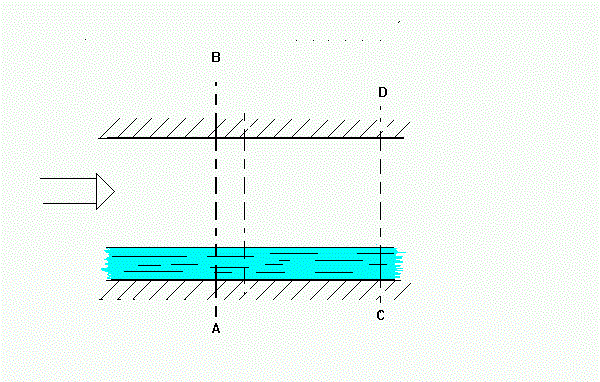
The amount of evaporated water in the surface portion dA can be expressed through the relationship:
dL = kv (psat – pv) dA, where kv is the evaporation function index.

The following expression describes the amount of heat (QD) removed from water during evaporation:
dQD = r dL    (3), where r is the heat of vaporization.

In equilibrium conditions, there is a balance between the amount of heat loss due to fluid evaporation and to  the quantity of heat  (Qc)  transferred to it by conduction: dQD = dQ

which written in terms of temperature leads to the following expression:
r dL = G cp dt
while in terms of heat exchange surface, we have:
r [kv (psat – pv)] dA = α (tG,DB- tL1) dA    (4)

Instead of  the psat and pv pressure functions, it's possible to calculate water quantity (dL) as a function of water contained in air or specific humidity (x); this gives an immediate idea of the amount of water vapor that is transferred to the air.

If pA and pV represent the partial pressures due to the above-mentioned components, the total pressure of the air is pT = p+ pV  (Dalton); since the steam is overheated and its behavior is very close to that of a perfect gas, it's possible to apply the law PV = RT; meaning that for the two components, after the appropriate steps, it's possible to describe water content in saturated air (xsat) as x.

PMV = molecular weight of water vapor = 18
PMG = molecular weight of the dry air »29

It's thus possible to obtain the values of saturation and water vapor pressure, respectively.
The simplified expressions have been written taking into account that generally, and especially, in the temperature range where cooling towers operate, the values pv and psat are small compared to the value of the total pressure, where the constant c is a function of the total pressure and of the molecular weights of the components.

All this allows rewriting equation (4), which after appropriate simplification becomes:
r [c kv (x sat - x)] = α (tG,DB- tL)

i.e., introducing the overall coefficient of mass transfer K = c (kV) in relation to the water content:
r (x sat - x) = (α / K) (tG,DB- tL)    (5)
then,
((tG,DB-tG,DB1) cp = (x1 - x) r        (6)

If we consider a channel of infinite length, we must attend a full compensation between water and air to the complete saturation, i.e., for which continues to be valid equation (6), hence:
(t-θe) c’p = (X’’e - X) r    (7)
when the temperature (θ) and the relative water content at saturation level (X’’e) are at fixed values, i.e., values that are known and do not vary can be considered both the specific heat of air (c’p). The evaporation heat (r): equation (7) shows that the relationship between temperature and water content in air is linear.

The temperature measured in air-saturated conditions, also called wet-bulb temperature or adiabatic saturation (tWB), is the limit temperature of water cooling.

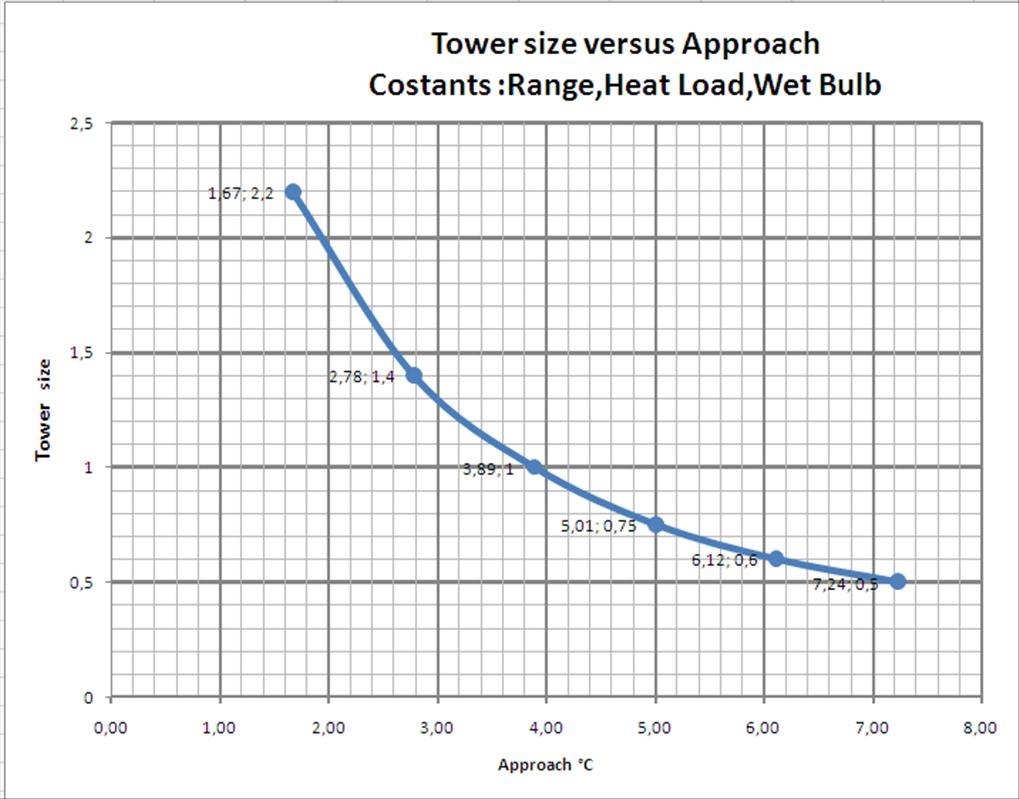
The above content wants to illustrate that the cooling water temperature for cooling towers cannot be lower than the wet-bulb temperature. Therefore, the greater the difference in temperature between cooling water and wet-bulb temperature (approach), determines a smaller cooling tower.
April 23, 2019

Evaporative Cooling Towers (part 3)


EVAPORATION OF FLUID INTO GAS

Cooling Towers


The following discussion is based on the following assumptions:

(1) Inside the water there is no heat exchange;
(2) The water that has decreased in volume, due to the evaporation effect, will be replenished with the same water that has evaporated to the surface.

In virtue of such assumptions, it's reasonable to assert that the water temperature doesn't undergo any variations along with the different layers of the water itself.

Conduction and convection 
The amount of heat that is transferred from air to water by conduction and convection can be expressed by the following law of conduction:
DQC = a (tG, DB- tL) dA or, in a fully equivalent manner, according to the definition of specific heat:

DQC = G cp dt = G

The amount of evaporated water at the surface of contact between the two fluids, air, and water, depends on the speed of vapor diffusion, that was created from mixing vapor-air. This is located near the interface between the two fluids.

According to the law of partial pressure (Dalton's law):
In a volume containing a mixture of several different gases or vapors at a given temperature, the value of the total pressure is the sum of the pressures, where each of the gases or vapors in the mixture components would have exerted separately. If by itself, it would occupy the entire volume.

pT = pA + pB + pC + ...

In other words, each gas in a mixture contributes with its partial pressure to the total pressure, as if acting independently from all others.
For example, the evaporation of water in an environment containing air continues to take place until the vapor produced reaches the required amount to fill the available volume and thus arriving at saturation, at the specific temperature of the environment taken under consideration.

The produced vapor exerts pressure as any other gas; this pressure is called vapor pressure and its value depends only by the fluid temperature. For this reason, the total pressure reached in the container – by which the determined temperature was reached, assumed constant, vaporization stops - at that determined temperature it exceeds the value of the initial pressure by an amount equal to the saturated vapor pressure.
Working at normal atmospheric pressures, Dalton's law of partial pressures finds the exact experimental results.
The vapor tension or pressure of saturated vapor on the water surface has the same value of saturation pressure (psatdetectable at water temperature (tL).


April 8, 2019

The importance of water in the cooling tower industry - Water (part 6)

SYSTEMS THAT COOL WATER IN AN EVAPORATIVE WAY: WHERE THEY ARE USED


A hint is given by knowing how refrigerators function in terms of "transfer of energy-heat". Although this topic is very interesting, we will not linger on the quality of energy.
We only need to know that not all energy is equal. There is no difference between the physical and mathematical way.
In practice, from an economic point of view, it is very important to know how to take advantage of the energy that is available.
We must say that the waste heat (energy that cannot be used) from plants, unfortunately, can only be used in a few plants. This is because their natural use in "cascade" presupposes that the plant being served needs to use the same amount of energy at the same time, and this is what makes more difficult. Let us recall that it's very difficult to store energy in an economically way.
Now we will discuss refrigerators

Contrary to what is known, refrigerators "do not produce cold." Cold cannot be produced, or make!
Cold is something you “feel", it exists because “it lacks” heat; in other words, we do not produce cold but we remove heat, hence, we have cold.
Refrigerating machines do the following: remove heat, or better carries heat from one system component (called evaporator) to another component (called condenser).
For example, to learn how much heat a refrigerator carries, it's enough to know the power of the engine required to make the refrigerator function. In practice, usually, 1 kW is required to "carry" about 2,500-3,000 kCal / h.

March 18, 2019

The importance of water in the cooling tower industry - Water (part 3)

COOLING WATER


http://turbosplash.blogspot.it/

The concept of temperature and heat

Temperature is a physical quantity that expresses the thermal state of an object. It is closely correlated to the amount of heat contained in the object itself.

A hot body is characterized by the amount of energy stored as heat. The amount of heat depends on the body mass and its specific heat (heat retention capacity).

When we speak of cooling we always almost think of refrigerators or temperatures that are lower than those of the environment we live in; on the other hand, when we speak of heating we think of fireplaces, electric heaters, etc., that is, temperatures that are higher than then the environment we live in. Hence. "hot" and "cold" are physical states which we are accustomed to "feel" or "perceive”.

Temperature and heat measurements
The temperature measurement is the degree "°C" for Celsius or "K" for Kelvin (K = ° C + 273).
The energy-heat measurement is the "J" (Joule).
Heat is normally related to time Js = power = W.

How to cool water in an economical way
A refrigerating machine uses a fair amount of energy to activate the process to transfer the heat, from a place that has to be cooled, to another place.

In evaporative cooling, however, the heat is transferred to air according to a physical principle that exploits the characteristics of the air to absorb moisture. This is very advantageous.

We, therefore, have moisture = water; water, which in our case contains heat.
The drier the more it can absorb moisture – water – heat.

Hence, hot and dry air can cool the water even at a temperature lower than air itself.

The importance of choosing the cold water temperature according to the process plant to cool
As we have seen, the cold water temperature is not very important as the difference in temperature at the outlet and inlet water liquor used as heat transport.

Let's not forget that our task with cooling towers is to dispose of heat. However, some plants in order to work better require low temperatures.

Condensers or heat exchangers of any one type are correlated to the cold water temperatures.

The choice of the outlet water temperature of the tower is, hence, of fundamental importance.

A tower is a machine that uses air as a cooling element.

The degree of the temperature is important to size the tower and need to be very careful in choosing the temperature.
A slight degree over the wet bulb air temperature forces us to increase the size of the tower, sometimes even double it!

Considering that the wet bulb temperature is very high for a few hours a year, we would have doubled the size of a plant for a few hours a year: an unforgivable economical mistake!

Imagine the waste and design error.

We can emphasize the fact that the difference in temperature between cold water and air, at wet bulb temperature, is a very important design piece of data because it is closely correlated with the size of the tower.

March 11, 2019

The importance of water in the cooling tower industry - Water (part 4)

UP TO WHAT TEMPERATURE CAN WATER BE COOLED

The capacity of air to cool water, according to latent heat. Practical benefits.

cooling tower

The physical states are well known: solid, liquid, gaseous.

When an element goes from one physical state to another, it frees energy but, at the same time, it requires energy. That is:
  • If a solid element changes from solid to liquid, it requires energy (e.g., a solid metal requires heat/energy to become liquid/molten);
  • in the reverse proceedings, the molten metal cools down (losing energy-heat) and becomes solid.
Other examples: a liquid that is heated to the right temperature, e.g., in the case of water it's 100 ° C, it evaporates and passes to the gaseous state. This is called "evaporation temperature". This process required heat, hence, energy.

Let us take a closer look:

  • We have employed heat-energy to heat up water to its evaporation temperature, which is 100 ° C.
By the definition of the unit of heat measurement, the amount of heat is determined in an exact way. In fact, 1 (one) calorie of energy is required to increase the temperature if 1 ° C in a liter of distilled water.
The increase in temperature, with respect to ambient temperature, is called "sensible heat". This is because it is perceived by one of our senses: touching.
If you put a finger in a pot of water that is heating up on top of a fire, we soon realize, or rather we feel, the increase in temperature. This is the sensible heat.

Let us now calculate how much sensible heat is required to bring a liter of normal tap water to the evaporation temperature. Normally, tap water comes out at a temperature of 15 ° C.

We mentioned that
  • the water must reach a temperature of 100 ° C to evaporate;
  • 1 calorie of energy is required to raise the temperature in a liter of water by 1 ° C. 
Hence, the 1 liter of tap water must be brought from 15 ° C to 100 ° C. The operation is simple arithmetic: 100 - 15 = 85 calories. So that the sensible heat of the water is 85 calories, and we have the same water at 100 ° C and, hence, in the evaporative state. If we continue to heat the water temperature will always remain at 100 ° C, but the water will evaporate until it is exhausted.

For the latter operation, 539 calories are required, which are called latent heat of vaporization. It's called latent because it's not detected since the water temperature will always be 100 ° C. 

This principle is also used in the kitchen to cook foods "in a water bath", that is, the food is cooked in a container immersed in another container containing water that is brought to the boiling point. With this method, the food will not exceed a cooking temperature of 100 ° C, with respect to fried foods or foods that are in direct contact with fire.

So we have seen that to evaporate one liter of tap water at 15 ° C, there is a need of 85 calories of heat sensitive and 539 calories of vaporization latent heat: a total of 624 Cal. This is a fixed datum.

To evaporate a liter of water it takes 624 calories.
Now let's try to do another experiment:

We have a liter of water and can make it evaporate with another stratagem. We will describe it in another paragraph, and it's not the pot on the stove. The new system will evaporate a liter of water by removing 539 calories, that is, the quantity of vaporization latent heat.

Remember, removing heat means cooling!

But let's see what is this thing that is well known since ancient times. First, we must use another element present in nature: air. 

The air, with the exception when it is raining, is not saturated with moisture. The air has the possibility to always absorb water up to its saturation. 

The air that we find in the environment, hence, has this important feature, which is to absorb water.

Absorb ...., hence, make evaporate.

By now the concept should be clear!

If we can "transfer" a liter of water to the air, we have transferred the 539 calories and the heat was removed with the new system (and not with the pot on the stove).

Air absorbs water, hence, latent heat from the water. This is the important phenomenon that we exploit to cool water in cooling towers. 

Relative humidity is the percentage of water vapor that the air holds under certain conditions, in relation to the amount of water vapor contained from saturated air in the same conditions.

Example:

If the relative humidity is 80% and the temperature is 20 ° C, since the saturated air contains 17.7 g / m3, the ambient air taken under consideration will contain 80% of the water, or better 0.8 x 17 7 = 14.6 grams of water per m3.

October 29, 2016

A cooling system is essential for the operation of any modern geothermal power plant

Cooling Tower System: Converting Geothermal Energy into Electricity
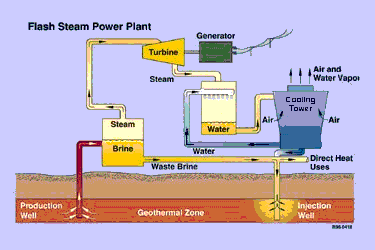
Example of flash power plant producing electricity

Heat emanates from the earth's interior and crust generates magma (molten rock). Because magma is less dense than surrounding rock, it rises but generally does not reach the surface, heating the water contained in rock pores and fractures. Wells are drilled into this natural collection of hot water or steam, called a geothermal reservoir, in order to bring it to the surface and use it for electricity production.
The whole process of turning hydro-thermal resources into electricity is based on conversion technologies. That is, there are three basic types of geothermal electrical generation facilities:
  • binary (it function as closed loop systems that make use of resource temperatures as low as (74°C),
  • steam (it makes use of a direct flow of geothermal steam), and
  • flash (uses a mixture of liquid water and steam).
Flash power plant is the most common and it uses a mixture of liquid water and steam.
The type depends on reservoir temperatures and pressures. Each type produces somewhat different environmental impacts.

Example of flash power plant producing electricity

The most common type of power plant to date is a flash power plant (flash steam is the condensation caused by reducing pressure) with a water cooling system, where a mixture of water and steam is produced from the wells. The steam is separated in a surface vessel (steam separator) and delivered to the turbine, and the turbine powers a generator.
A cooling system is essential for the operation of any modern geothermal power plant, because cooling towers prevent turbines from overheating and prolong facility life. Most power plants, including most geothermal plants, use water cooling systems.
Water cooled systems generally require less land than air cooled systems, and are considered overall to be effective and efficient cooling systems. The evaporative cooling used in water cooled systems, however, requires a continuous supply of cooling water and creates vapor plumes. Usually, some of the spent steam from the turbine (for flash- and steam-type plants) can be condensed for this purpose.
Reliability of Geothermal Power Generation
The source of geothermal energy, heat from the earth, is available 24 hours a day, 365 days a year. Solar and wind energy sources, in contrast, are dependent upon a number of factors, including daily and seasonal fluctuations and weather variations. For these reasons, electricity from geothermal energy is more consistently available, once the resource is tapped, than many other forms of electricity.
Examples of Power Plant Size and Applications
Though the size of a power plant is determined primarily by resource characteristics, these are not the only determining factors. Factors that favor the development of larger geothermal plants include things such as cost decreases when larger quantities of materials, including steel, concrete, oil, and fuel, are purchased at one time.
Cooling System
Most power plants, including most geothermal plants, use water-cooled systems – typically in cooling towers.

References/Sources
- Idaho National Lab (INL)
- Wikipedia
- Geothermal Energy Association
- U.S. Department of Energy
 
********** 
Software Calculator for cooling tower design and maintenance and TURBOsplash PAC ™ for filling material.
**********

September 26, 2016

The importance of water in the cooling tower industry - Water (part 7)

Process plants that can be cooled with evaporation systems.
The importance of disposing quantity of energy.
Efficiency of the cooling system.

NERI Calculator
Image from previous post "NERI Calculator". Click on the above image to learn more about the calculator. 
From what has been written on this subject, the disposal of heat from evaporative cooling towers use something in particular, that is, disposing large amounts of heat from the water by means of the air: two natural elements.
Heat disposal has, therefore, a relatively low cost.

To name a few examples where towers are used:
(a) disposing heat from the various refrigeration groups and city building air conditioning condensers.
(b) in industries such as oil refineries, chemical plants,
(c) in industrial process plants for the production of food products,
(d) in thermoelectric power plants,
(e) in geothermal systems.
(f) …
Obviously each type of installation has different requirements for heat disposal (amount of cooled water). Temperatures and their range must be designed appropriately and carefully, and, most of all, the air thermal characteristic data to be considered for cooling tower design.
Air data has to include temperature, humidity and altitude related to the location of the tower. These three values (temperature, humidity, altitude) are very important.
If the data is not chosen correctly, this can lead to the wrong tower sizing, up to three or four times higher, or lower, than the actual needs of the system.

If the tower sizing is higher than the correct value, this will lead to waste of material and, hence, higher cost of the system. On the other hand, if faulty sizing will lead to equipment that is not adequate to the system, hence, useless!

September 19, 2016

NERI Calculator

Calculator www.nericalc.com
When it comes to evaporative water cooling towers, whether you're are part of the design team or maintenance operations, NERI Calculator helps ensure that the functionality of the tower is optimal and efficient, hence, maintaining plant's productivity at maximum level.

Design
For maximum efficiency, in the design phase of the evaporative cooling tower project, NERI Calculator returns the optimal size of the tower needed to serve a predesigned plant system.

Maintenance
In normal maintenance operations, NERI Calculator verifies tower performance based on the actual tower data.

What are the risks of a poor functioning tower?
  • Tower driven system will not function correctly
  • Loss of productivity of the plant
  • Could cause heavy damage
  • Impact on the Environment
The cost of running a bad designed cooling tower could be high!
NERI Calculator covers two type of evaporative water cooling towers:
  • Counter-flow: a water cooling tower design where the air-flow is directly opposite of the water-flow.
  • Cross-flow: a water cooling tower system design in which the air-flow is directed perpendicular to the water-flow. Air flow enters one or more vertical faces of the cooling tower to meet the fill material.
If your tower is counter-flow, then try our NERI Calculator tool for free. When you sign up, we offer you a 1-day free trial of 50 calculations.
If your tower is cross-flow, then contact us and we'll do the calculations for you.
NERI Calculator is not only used for design purposes, but it's a tool to use always during on-going activities for monitoring and controlling cooling tower performance.

“Prevention is better than cure”
NERI Calculator will prevent damages resulting from a poorly functioning cooling tower, by verifying that the data is correct and/or has not been modified. Poor functioning cooling towers will have bad consequences not only on the cooling tower, but mostly on any production system served by the tower. All this damage and loss can be translated in huge economic loss!

How to use NERI Calculator:

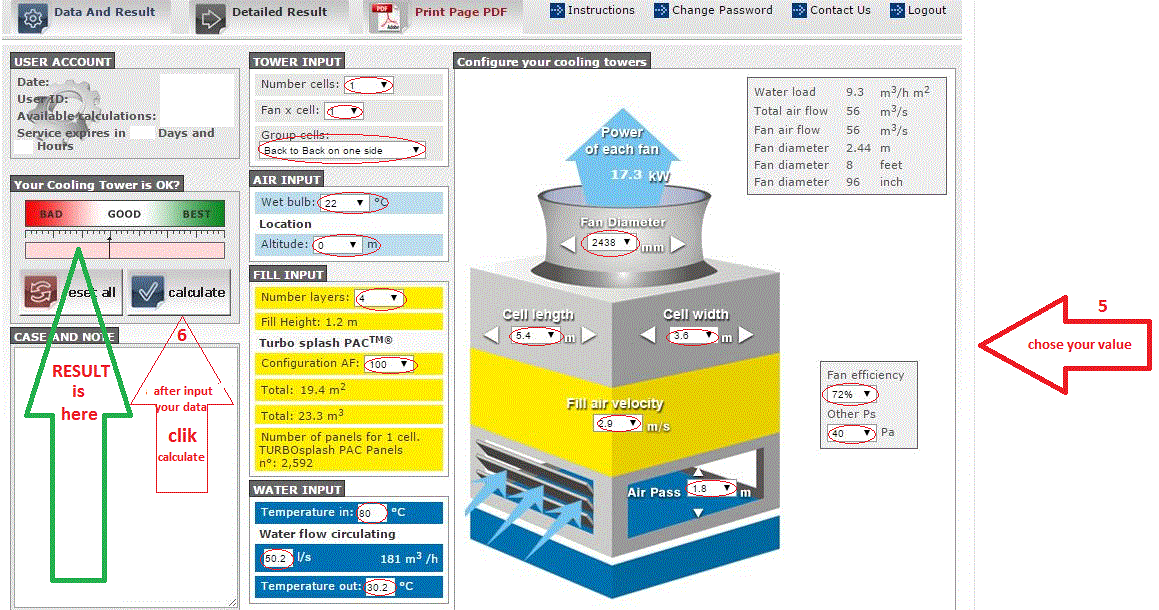
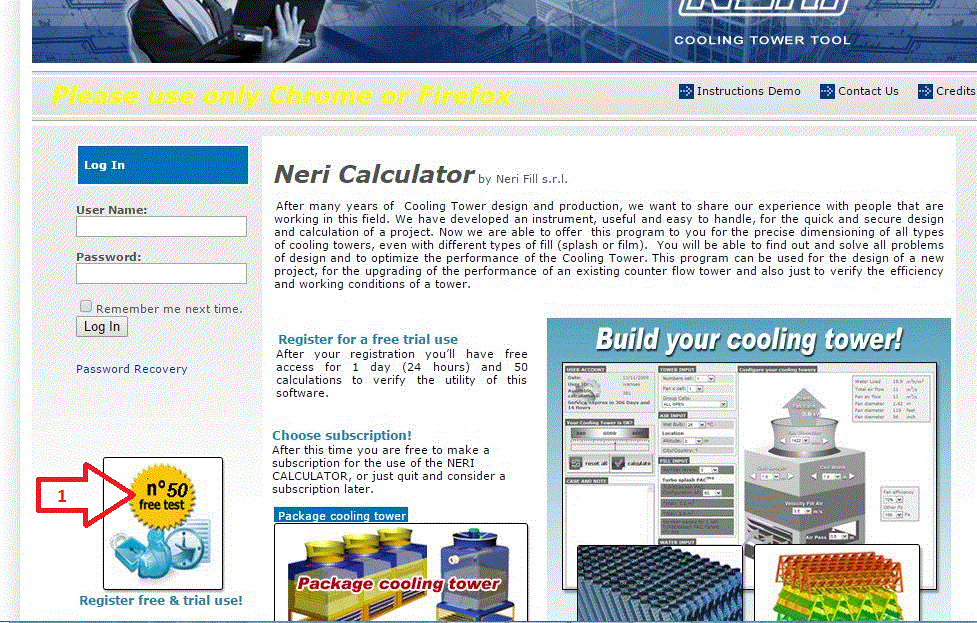
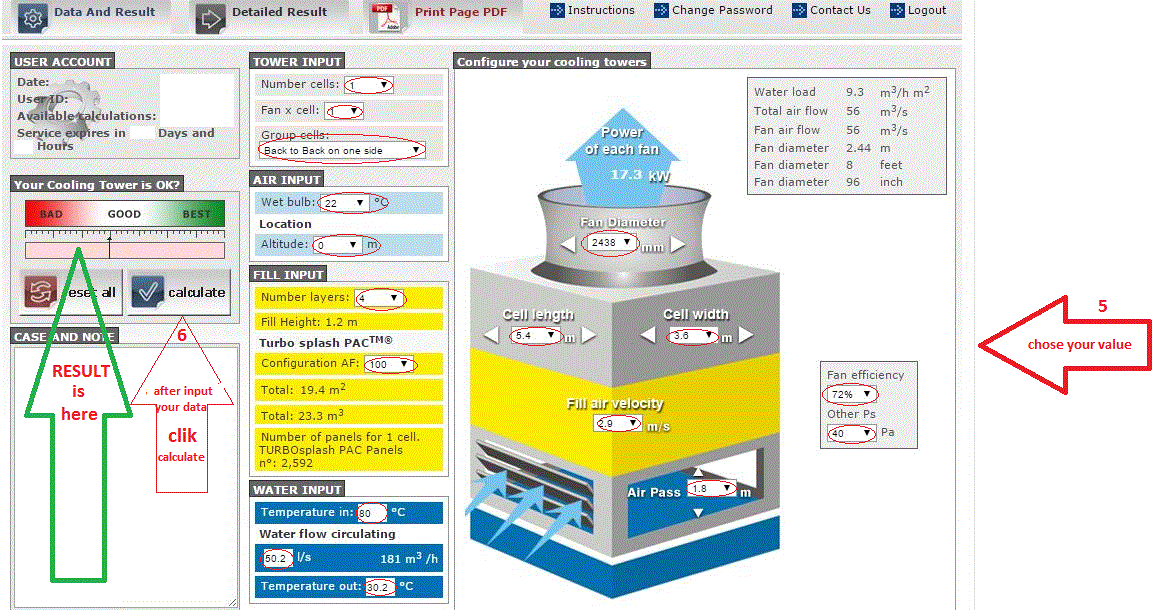
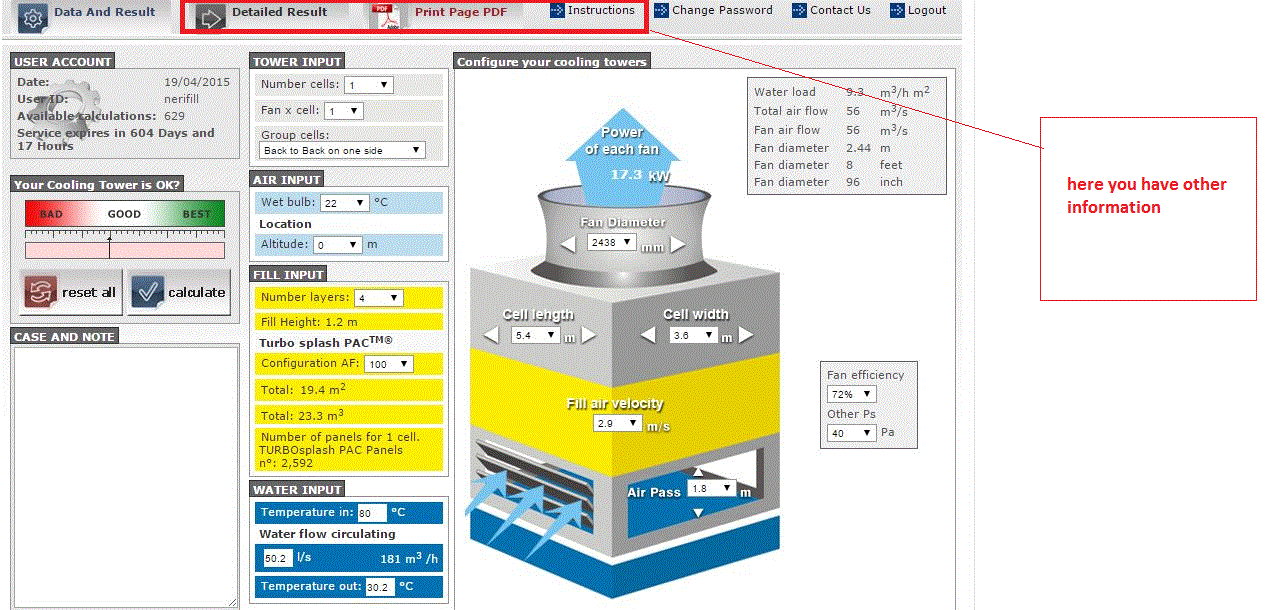
Go to page www.nericalc.com and follow the steps as described in the below 6 diagrams.

STEP 1
Cooling Tower
Diagram 1
STEP 2


Cooling Tower
Diagram 2


STEP 3 AND 4

Cooling Tower
Diagram 3 
STEP 5 AND 6

STEP 5 - 6  and RESULT.gif
Diagram 4


FINAL DATA


Cooling Tower
Diagram 5

PRICE
Cooling Tower
Diagram 6

September 13, 2016

The importance of water in the cooling tower industry - Water (part 6)

SYSTEMS THAT COOL WATER IN AN EVAPORATIVE WAY: WHERE THEY ARE USED


A hint is given by knowing how refrigerators function in terms of "transfer of energy-heat". Although this topic is very interesting, we will not linger on the quality of energy.
We only need to know that not all energy is equal. There is no difference between the physical and mathematical way.
In practice, from an economic point of view, it is very important to know how to take advantage of the energy that is available.
We must say that the waste heat (energy that cannot be used) from plants, unfortunately, can only be used in few plants. This is because their natural use in "cascade" presupposes that the plant being served needs to use the same amount of energy at the same time, and this is what makes more difficult. Let us recall that it's very difficult to store energy in an economically way.
Now we will discuss about refrigerators

Contrary to what is known, refrigerators "do not produce cold." Cold cannot be produced, or make!
Cold is something you “feel", it exists because “it lacks” heat; in other words, we do not produce cold but we remove heat, hence, we have cold.
Refrigerating machines do the following: remove heat, or better carries heat from one system component (called evaporator) to another component (called condenser).
For example, to learn how much heat a refrigerator carries, it's enough to know the power of the engine required to make the refrigerator function. In practice, usually, 1 kW is required to "carry" about 2,500-3,000 kCal / h.

September 5, 2016

Evaporative Cooling Towers (part 4)

Evaporation
Nerifill
The amount of evaporated water in the surface portion dA can be expressed through the relationship:
dL = kv (psat – pv) dA
where kv is the evaporation function index.
 The following expression describes the amount of heat (QD) removed from water during evaporation:
dQD = r dL    (3)
where r is the heat of vaporization.
In equilibrium conditions, there is a balance between the amount of heat lost due to fluid evaporation and to  the quantity of heat  (Qc)  transferred to it by conduction:
dQD = dQc
which written in terms of temperature leads to the following expression:
r dL = G cp dt
while in terms of heat exchange surface, we have:
r [kv (psat – pv)] dA = α (tG,DB- tL1) dA    (4)
Instead of  the psat and pv pressure functions, it's possible to calculate water quantity (dL) as a function of water contained in air or specific humidity (x); this gives an immediate idea of the amount of water vapor that is transferred to the air.
If pA and pV represent the partial pressures due to the above mentioned components, the total pressure of the air is pT = pA + pV  (Dalton); since the steam is overheated and its behavior is very close to that of a perfect gas, it's possible to apply the law PV = RT; meaning that for the two components, after the appropriate steps, it's possible to describe water content in saturated air (xsat) as x.
PMV = molecular weight of water vapor = 18
PMG = molecular weight of the dry air »29
It's thus possible to obtain the values of saturation and water vapor pressure, respectively.
The simplified expressions have been written taking into account that generally, and especially, in the temperature range where cooling towers operate, the values pv and psat are small compared to the value of the total pressure, where the constant c is a function of the total pressure and of the molecular weights of the components.
All this allows to rewrite equation (4), which after appropriate simplification, becomes:
r [c kv (x sat - x)] = α (tG,DB- tL)
i.e., introducing the overall coefficient of mass transfer K = c (kV) in relation to the water content:
r (x sat - x) = (α / K) (tG,DB- tL)    (5)
then,
((tG,DB-tG,DB1) cp = (x1 - x) r        (6)
If we consider a channel of infinite length, we must attend a full compensation between water and air to the complete saturation, i.e., for which continues to be valid equation (6), hence:
(t-θe) c’p = (X’’e - X) r    (7)
when the temperature (θe ) and the relative water content at saturation level (X’’e) are at fixed values, i.e., values that are known and do not vary can be considered both the specific heat of air (c’p). The evaporation heat (r): equation (7) shows that the relationship between temperature and water content in air is linear.
The temperature measured in air saturated conditions, also called wet-bulb temperature or adiabatic saturation (tWB), is the limit temperature of water cooling.
The above content wants to illustrate that the cooling water temperature for cooling towers cannot be lower than the wet-bulb temperature. Therefore, the greater the difference of temperature between cooling water and wet-bulb temperature (approach), determines a smaller cooling tower.