TURBOsplash PAC ®™ is employed in water cooling towers, where the two elements are water and air. This material is used by prestigious companies that build cooling towers or replace/retrofit traditional material (film and grids). As a result, the increased performance is sensitive and allows for a long functioning period. TURBOsplash PAC ®™ was invented by Bruno Neri and now commercialised by TSI company and other partners under authorized license. It is patented in most industrialized countries, where it is installed and in use with satisfied customers for over 25 years.
Pages
Build and/or verify cooling tower performance and efficiency with TURBOsplash PAC ®™ and NERI Calculator
Labels
Comments on cooling tower
(1)
Cooling Tower Calculations
(28)
Cooling Towers
(18)
Cross-flow and Counter-flow
(25)
Energy
(37)
Environment
(35)
Evaporative Cooling Towers
(42)
Geothermal Energy
(5)
Heat Transfer
(15)
How to Design the Water Cooling Towers
(34)
How to Design Water Cooling Towers
(25)
NERI Calculator
(15)
Optimizing
(7)
Software cooling tower
(6)
TURBOsplash PAC ®™
(24)
Water
(27)
Water Cooling Tower
(28)
Water Cooling Towers
(4)
What happens inside TURBOsplash PAC
(6)
what happens inside TURBOsplashPAC ® TM
(7)
Why install TURBOsplash PAC ®™
(4)
Why install TURBOsplashPAC ® TM
(11)
Showing posts with label Water Cooling Tower. Show all posts
September 9, 2019
TURBOsplash PAC ®™ - What is it?
TURBOsplash PAC ®™ is a filling material for systems that exploit the physical principle of "mass transfer" to migrate from one element to another.
June 24, 2019
Industrial water cooling with TURBOsplash PAC ®™ installed in severe conditions
TURBOsplash PAC ®™ installed and functioning with water containing high percentage of oil and grease.
|
| Installed fill film with water containing high percentage of oil and grease. |
![]() |
| TURBOsplash PAC ®™ ready for installation in the tower. |
![]() |
| Cooling tower with TURBOsplash PAC ®™ installed in severe conditions. |
June 10, 2019
TURBOsplash PAC ®™ fill material panels
Images of TURBOsplash PAC ®™ fill material panels, packaged and prepared for shipment/install in cooling towers.
April 29, 2019
Evaporative Cooling Towers (part 4)
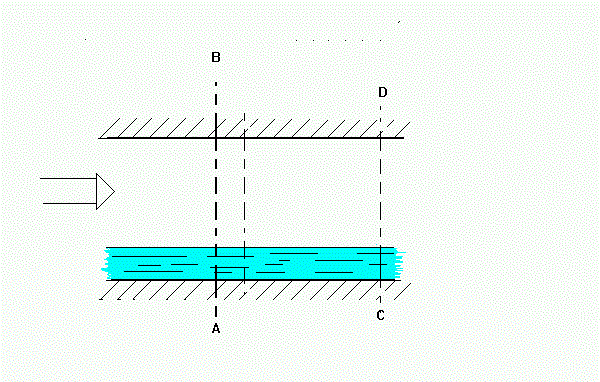
The amount of evaporated water in the surface portion dA can
be expressed through the relationship:
dL = kv (psat – pv)
dA, where kv is the evaporation function index.
The following expression describes the amount of heat
(QD) removed from water during evaporation:
dQD = r dL (3), where r is the heat of vaporization.
In equilibrium conditions, there is a balance between the
amount of heat loss due to fluid evaporation and to the quantity of heat
(Qc) transferred to it by conduction: dQD = dQc
which written in terms of temperature leads to the following
expression:
r dL = G cp dt
while in terms of heat exchange surface, we have:
r [kv (psat –
pv)] dA = α (tG,DB-
tL1) dA (4)
Instead of the psat and pv pressure
functions, it's possible to calculate water quantity (dL) as a function of
water contained in air or specific humidity (x); this gives an immediate idea
of the amount of water vapor that is transferred to the air.
If pA and pV represent the
partial pressures due to the above-mentioned components, the total pressure of
the air is pT = pA + pV (Dalton);
since the steam is overheated and its behavior is very close to that of a
perfect gas, it's possible to apply the law PV = RT; meaning that for the two
components, after the appropriate steps, it's possible to describe water
content in saturated air (xsat) as x.
PMV = molecular weight of water vapor = 18
PMG = molecular weight of the dry air »29
It's thus possible to obtain the values of saturation and
water vapor pressure, respectively.
The simplified expressions have been written taking into
account that generally, and especially, in the temperature range where cooling
towers operate, the values pv and psat are
small compared to the value of the total pressure, where the constant
c is a function of the total pressure and of the molecular weights of the
components.
All this allows rewriting equation (4), which after
appropriate simplification becomes:
r [c kv (x sat - x)]
= α (tG,DB- tL)
i.e., introducing the overall coefficient of mass
transfer K = c (kV) in relation to the water content:
r (x sat - x) = (α / K) (tG,DB-
tL) (5)
then,
((tG,DB-tG,DB1) cp =
(x1 - x) r (6)
If we consider a channel of infinite length, we must attend
a full compensation between water and air to the complete saturation,
i.e., for which continues to be valid equation (6), hence:
(t-θe) c’p = (X’’e -
X) r (7)
when the temperature (θe ) and the
relative water content at saturation level (X’’e) are at fixed
values, i.e., values that are known and do not vary can be considered both the
specific heat of air (c’p). The evaporation heat (r): equation (7)
shows that the relationship between temperature and water content in air is
linear.
The temperature measured in air-saturated conditions, also
called wet-bulb temperature or adiabatic saturation (tWB), is the
limit temperature of water cooling.
The above content wants to illustrate that the cooling water
temperature for cooling towers cannot be lower than the wet-bulb temperature.
Therefore, the greater the difference in temperature between cooling water and
wet-bulb temperature (approach), determines a smaller cooling tower.
April 23, 2019
Evaporative Cooling Towers (part 3)
EVAPORATION OF FLUID INTO GAS
The following discussion
is based on the following assumptions:
(1) Inside the water
there is no heat exchange;
(2) The water that has
decreased in volume, due to the evaporation effect, will be replenished with
the same water that has evaporated to the surface.
In virtue of such assumptions, it's reasonable to assert that the water temperature doesn't undergo any variations along with the different layers of the water itself.
Conduction and convection
The amount of heat that
is transferred from air to water by conduction and convection can be expressed
by the following law of conduction:
DQC = a (tG, DB- tL) dA or, in a fully equivalent manner, according to
the definition of specific heat:
DQC = G cp dt = G
The amount of evaporated
water at the surface of contact between the two fluids, air, and water, depends
on the speed of vapor diffusion, that was created from mixing vapor-air. This
is located near the interface between the two fluids.
According to the law of
partial pressure (Dalton's law):
In a volume containing a
mixture of several different gases or vapors at a given temperature, the value
of the total pressure is the sum of the pressures, where each of the gases or
vapors in the mixture components would have exerted separately. If by itself,
it would occupy the entire volume.
pT = pA + pB + pC + ...
In other words, each gas
in a mixture contributes with its partial pressure to the total pressure, as if
acting independently from all others.
For example, the
evaporation of water in an environment containing air continues to take place
until the vapor produced reaches the required amount to fill the available
volume and thus arriving at saturation, at the specific temperature of the
environment taken under consideration.
The produced vapor exerts
pressure as any other gas; this pressure is called vapor pressure and its value
depends only by the fluid temperature. For this reason, the total pressure
reached in the container – by which the determined temperature was reached,
assumed constant, vaporization stops - at that determined temperature it
exceeds the value of the initial pressure by an amount equal to the saturated
vapor pressure.
Working at normal
atmospheric pressures, Dalton's law of partial pressures finds the exact
experimental results.
The vapor tension or
pressure of saturated vapor on the water surface has the same value of
saturation pressure (psat) detectable at water
temperature (tL).
April 15, 2019
Evaporative Cooling Towers (part 2)
| WATER-AIR TURBULENCE |
Water cooling takes place according to three phenomena:
1. CONDUCTION: (disposal of sensible heat1).
The heat flows from a region with a higher temperature to a region with a lower temperature through one or more means that are in direct physical contact, in compliance with the laws of heat conduction (Fourier Transform). Energy is transmitted by direct contact between the molecules, and the potential that governs this phenomenon is the difference of temperature between the two different regions.
2. EVAPORATION: (disposal of latent heat2).
The change of state from liquid to vapor causes the absorption, from the side of the evaporated mass unit, of a quantity of heat called evaporation latent heat, which causes the cooling of the mass unit that remained in the liquid state.
The potential difference that governs this phenomenon is due to the difference of concentration levels, which for the gas phase it's expressed in terms of partial pressures assuming we're using assimilated gases to ideal gases.
The loss of energy and, consequently, the obtained cooling, with the transfer of latent heat, is important: to evaporate one kilogram of water there is a need to dispose of approximately 540 kcal or 2257 kJ (evaporization latent heat), i.e., 100 liters of water gets cooled to about 6 ° C ..
3. IRRADIATION
Electromagnetic waves propagation, in absence of physical contact, make heat flow from a body that has a greater temperature to a body with a lower temperature. When the radiation emitted by a body meet another body, their energy remains absorbed near the surface.
Thermal exchange by irradiation becomes always more important as the temperature of a body increases, and in the case of temperatures close to the atmospheric ones, the irradiation can be neglected.
We can again highlight the concept that the evaporative towers are essentially based on the use of latent heat by mixing air stream with water flow, by which a small part evaporates by passing through the air current, taking away latent heat from the remaining water.
The heat removed from the water will be dispersed in the environment as water vapor that is contained in the outgoing air stream, so that it will be more humid and warmer with respect to the incoming air.
The water exiting the tower will be colder but in smaller quantities than the incoming water. This is the reason that the tower is replenished with make-up water in quantities (Wo) equal to that lost by evaporation and temperature qo.
Principles
1. Thermal balance (first principle of thermodynamics)
In the following set of equations, we are neglecting the effect of the barometric pressure; although in some cases, for example, plant installations that are 500 meters above sea level, the barometric pressure is important because it helps to vary pressures relative to air.
Cooling system thermal balance
- Q + (Wo qo ).= L(i2 - i1)
- Q = W( q2 - q1).+ Wo( q1 - q0).
- W( q2 - q1).+ Wo( q1 ).= L(i2 – i1)
From the moment the amount of make-up water (Wo) is not thermally significant with respect to the total quantity of water W.
1Sensible heat is the one that transferred/subtracted to/from a body varies the temperature.
2Latent heat is the one that transferred/subtracted to/from a substance causes the physical state to vary.
April 8, 2019
The importance of water in the cooling tower industry - Water (part 6)
SYSTEMS THAT COOL WATER IN AN EVAPORATIVE WAY: WHERE THEY ARE USED
A hint is given by knowing how refrigerators function in terms of "transfer of energy-heat". Although this topic is very interesting, we will not linger on the quality of energy.
We only need to know that not all energy is equal. There is no difference between the physical and mathematical way.
In practice, from an economic point of view, it is very important to know how to take advantage of the energy that is available.
We must say that the waste heat (energy that cannot be used) from plants, unfortunately, can only be used in a few plants. This is because their natural use in "cascade" presupposes that the plant being served needs to use the same amount of energy at the same time, and this is what makes more difficult. Let us recall that it's very difficult to store energy in an economically way.
Now we will discuss refrigerators
Contrary to what is known, refrigerators "do not produce cold." Cold cannot be produced, or make!
Cold is something you “feel", it exists because “it lacks” heat; in other words, we do not produce cold but we remove heat, hence, we have cold.
Refrigerating machines do the following: remove heat, or better carries heat from one system component (called evaporator) to another component (called condenser).
For example, to learn how much heat a refrigerator carries, it's enough to know the power of the engine required to make the refrigerator function. In practice, usually, 1 kW is required to "carry" about 2,500-3,000 kCal / h.
March 11, 2019
The importance of water in the cooling tower industry - Water (part 4)
UP TO WHAT TEMPERATURE CAN WATER BE COOLED
The capacity of air to cool water, according to latent heat. Practical benefits.
The physical states are well known: solid, liquid, gaseous.
When an element goes from one physical state to another, it frees energy but, at the same time, it requires energy. That is:
- If a solid element changes from solid to liquid, it requires energy (e.g., a solid metal requires heat/energy to become liquid/molten);
- in the reverse proceedings, the molten metal cools down (losing energy-heat) and becomes solid.
Let us take a closer look:
- We have employed heat-energy to heat up water to its evaporation temperature, which is 100 ° C.
The increase in temperature, with respect to ambient temperature, is called "sensible heat". This is because it is perceived by one of our senses: touching.
If you put a finger in a pot of water that is heating up on top of a fire, we soon realize, or rather we feel, the increase in temperature. This is the sensible heat.
Let us now calculate how much sensible heat is required to bring a liter of normal tap water to the evaporation temperature. Normally, tap water comes out at a temperature of 15 ° C.
We mentioned that:
- the water must reach a temperature of 100 ° C to evaporate;
- 1 calorie of energy is required to raise the temperature in a liter of water by 1 ° C.
For the latter operation, 539 calories are required, which are called latent heat of vaporization. It's called latent because it's not detected since the water temperature will always be 100 ° C.
This principle is also used in the kitchen to cook foods "in a water bath", that is, the food is cooked in a container immersed in another container containing water that is brought to the boiling point. With this method, the food will not exceed a cooking temperature of 100 ° C, with respect to fried foods or foods that are in direct contact with fire.
So we have seen that to evaporate one liter of tap water at 15 ° C, there is a need of 85 calories of heat sensitive and 539 calories of vaporization latent heat: a total of 624 Cal. This is a fixed datum.
To evaporate a liter of water it takes 624 calories.
Now let's try to do another experiment:
We have a liter of water and can make it evaporate with another stratagem. We will describe it in another paragraph, and it's not the pot on the stove. The new system will evaporate a liter of water by removing 539 calories, that is, the quantity of vaporization latent heat.
Remember, removing heat means cooling!
But let's see what is this thing that is well known since ancient times. First, we must use another element present in nature: air.
We have a liter of water and can make it evaporate with another stratagem. We will describe it in another paragraph, and it's not the pot on the stove. The new system will evaporate a liter of water by removing 539 calories, that is, the quantity of vaporization latent heat.
Remember, removing heat means cooling!
But let's see what is this thing that is well known since ancient times. First, we must use another element present in nature: air.
The air, with the exception when it is raining, is not saturated with moisture. The air has the possibility to always absorb water up to its saturation.
The air that we find in the environment, hence, has this important feature, which is to absorb water.
Absorb ...., hence, make evaporate.
By now the concept should be clear!
If we can "transfer" a liter of water to the air, we have transferred the 539 calories and the heat was removed with the new system (and not with the pot on the stove).
Air absorbs water, hence, latent heat from the water. This is the important phenomenon that we exploit to cool water in cooling towers.
Relative humidity is the percentage of water vapor that the air holds under certain conditions, in relation to the amount of water vapor contained from saturated air in the same conditions.
Example:
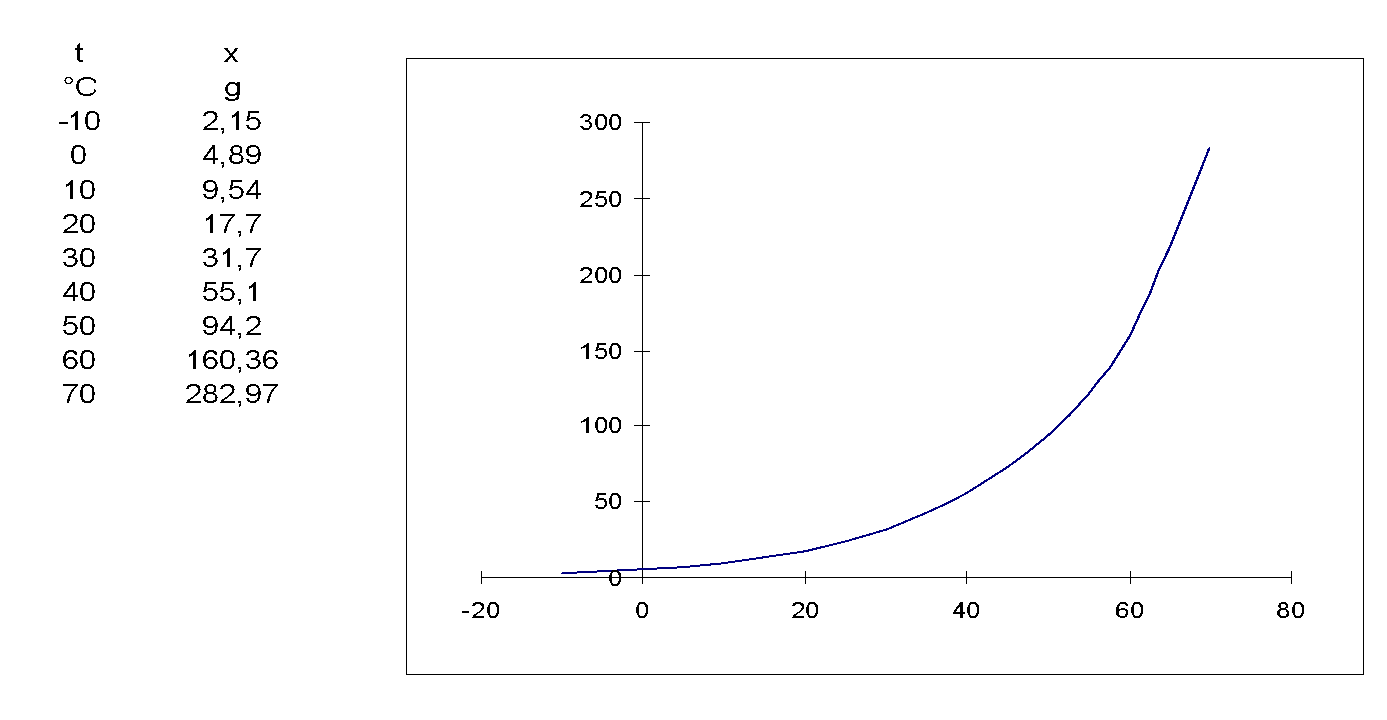
If the relative humidity is 80% and the temperature is 20 ° C, since the saturated air contains 17.7 g / m3, the ambient air taken under consideration will contain 80% of the water, or better 0.8 x 17 7 = 14.6 grams of water per m3.
October 1, 2016
The importance of water in the cooling tower industry - Water (part 8)
COOLING TOWER
Cooling tower design require water and air related data.
Data concerning the water include flow rate, water temperature going into the tower, and temperature going out of the tower. This data is provided by the cooling tower plant design.
Data concerning the air is provided by weather statistics site where the tower is located or where it will be installed, and is given in percentage hours per year or summer dry bulb temperature and relative humidity, measured at the same instant of detection of the dry bulb temperature.
The amount of air required in the tower is given by the design results, and the size of the cooling tower depends directly on this data.
Hence, one must determine the air velocity inside the tower, the power of the fan motors, and all the characteristics of the tower sized based on the efficiency of individual components, including the main component which is the fill material that allows heat exchange of water / air.
Cooling tower design require water and air related data.
Data concerning the water include flow rate, water temperature going into the tower, and temperature going out of the tower. This data is provided by the cooling tower plant design.
Data concerning the air is provided by weather statistics site where the tower is located or where it will be installed, and is given in percentage hours per year or summer dry bulb temperature and relative humidity, measured at the same instant of detection of the dry bulb temperature.
The amount of air required in the tower is given by the design results, and the size of the cooling tower depends directly on this data.
Hence, one must determine the air velocity inside the tower, the power of the fan motors, and all the characteristics of the tower sized based on the efficiency of individual components, including the main component which is the fill material that allows heat exchange of water / air.
September 13, 2016
The importance of water in the cooling tower industry - Water (part 6)
SYSTEMS THAT COOL WATER IN AN EVAPORATIVE WAY: WHERE THEY ARE USED
A hint is given by knowing how refrigerators function in terms of "transfer of energy-heat". Although this topic is very interesting, we will not linger on the quality of energy.
We only need to know that not all energy is equal. There is no difference between the physical and mathematical way.
In practice, from an economic point of view, it is very important to know how to take advantage of the energy that is available.
We must say that the waste heat (energy that cannot be used) from plants, unfortunately, can only be used in few plants. This is because their natural use in "cascade" presupposes that the plant being served needs to use the same amount of energy at the same time, and this is what makes more difficult. Let us recall that it's very difficult to store energy in an economically way.
Now we will discuss about refrigerators
Contrary to what is known, refrigerators "do not produce cold." Cold cannot be produced, or make!
Cold is something you “feel", it exists because “it lacks” heat; in other words, we do not produce cold but we remove heat, hence, we have cold.
Refrigerating machines do the following: remove heat, or better carries heat from one system component (called evaporator) to another component (called condenser).
For example, to learn how much heat a refrigerator carries, it's enough to know the power of the engine required to make the refrigerator function. In practice, usually, 1 kW is required to "carry" about 2,500-3,000 kCal / h.
September 5, 2016
Evaporative Cooling Towers (part 4)
Evaporation
The amount of evaporated water in the surface portion dA can be expressed through the relationship:
dL = kv (psat – pv) dA
where kv is the evaporation function index.
The following expression describes the amount of heat (QD) removed from water during evaporation:
dQD = r dL (3)
where r is the heat of vaporization.
In equilibrium conditions, there is a balance between the amount of heat lost due to fluid evaporation and to the quantity of heat (Qc) transferred to it by conduction:
dQD = dQc
which written in terms of temperature leads to the following expression:
r dL = G cp dt
while in terms of heat exchange surface, we have:
r [kv (psat – pv)] dA = α (tG,DB- tL1) dA (4)
Instead of the psat and pv pressure functions, it's possible to calculate water quantity (dL) as a function of water contained in air or specific humidity (x); this gives an immediate idea of the amount of water vapor that is transferred to the air.
If pA and pV represent the partial pressures due to the above mentioned components, the total pressure of the air is pT = pA + pV (Dalton); since the steam is overheated and its behavior is very close to that of a perfect gas, it's possible to apply the law PV = RT; meaning that for the two components, after the appropriate steps, it's possible to describe water content in saturated air (xsat) as x.
PMV = molecular weight of water vapor = 18
PMG = molecular weight of the dry air »29
It's thus possible to obtain the values of saturation and water vapor pressure, respectively.
The simplified expressions have been written taking into account that generally, and especially, in the temperature range where cooling towers operate, the values pv and psat are small compared to the value of the total pressure, where the constant c is a function of the total pressure and of the molecular weights of the components.
All this allows to rewrite equation (4), which after appropriate simplification, becomes:
r [c kv (x sat - x)] = α (tG,DB- tL)
i.e., introducing the overall coefficient of mass transfer K = c (kV) in relation to the water content:
r (x sat - x) = (α / K) (tG,DB- tL) (5)
then,
((tG,DB-tG,DB1) cp = (x1 - x) r (6)
If we consider a channel of infinite length, we must attend a full compensation between water and air to the complete saturation, i.e., for which continues to be valid equation (6), hence:
(t-θe) c’p = (X’’e - X) r (7)
when the temperature (θe ) and the relative water content at saturation level (X’’e) are at fixed values, i.e., values that are known and do not vary can be considered both the specific heat of air (c’p). The evaporation heat (r): equation (7) shows that the relationship between temperature and water content in air is linear.
The temperature measured in air saturated conditions, also called wet-bulb temperature or adiabatic saturation (tWB), is the limit temperature of water cooling.
The above content wants to illustrate that the cooling water temperature for cooling towers cannot be lower than the wet-bulb temperature. Therefore, the greater the difference of temperature between cooling water and wet-bulb temperature (approach), determines a smaller cooling tower.
Subscribe to:
Posts (Atom)